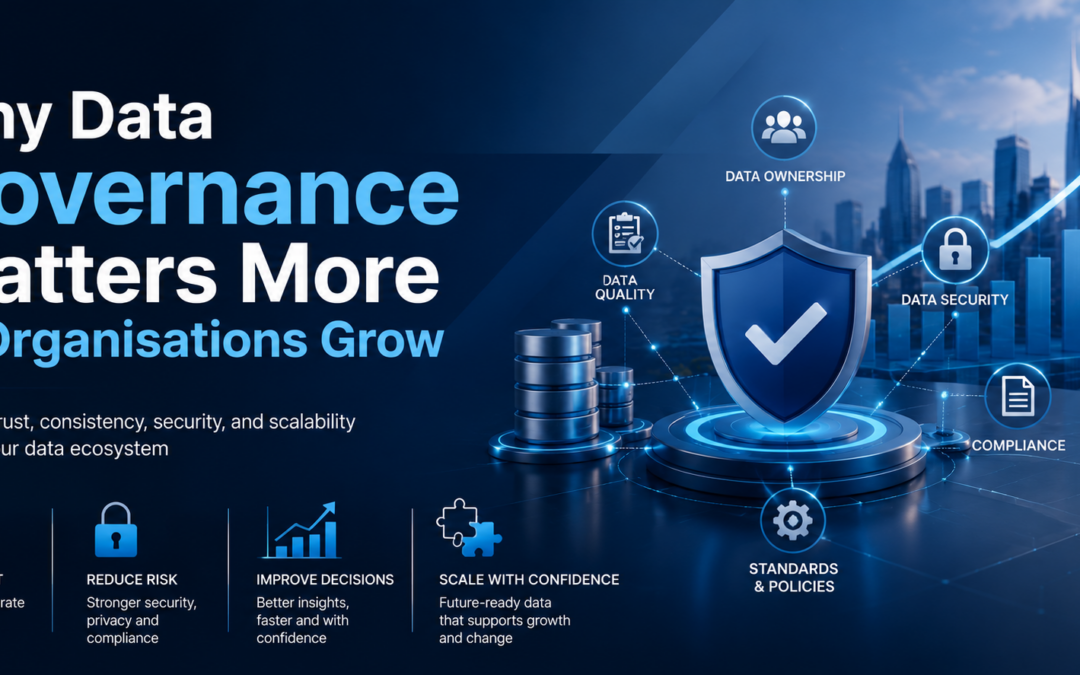
Data governance is a core part of strong data foundations for any business, not just large or highly regulated ones. It creates the structure around how data is defined, owned, accessed, protected, and maintained, which makes it easier to trust, use, and scale over time. That matters in day-to-day reporting, but it becomes especially important during periods of change and growth, such as data migrations, system upgrades, and new software implementations. Whether a business is moving to a new ERP, CRM, cloud platform, or reporting environment, governance helps ensure data is consistent, secure, and fit for purpose before it lands in the new system.
Start With The Foundations: Can Your Data Support The Plan?
Before a business starts improving dashboards or asking more of its reporting, it needs to know whether the underlying data is in good enough shape to support that work. If information is still scattered across systems, pulled together manually, or stored in ways that make consistency difficult, any strategy built on top of it is going to feel harder than it should.
That’s why the first step we recommend is usually quite simple: check the foundations. Look at where data lives, how easily it can be accessed, and whether the current setup is giving teams a reliable view of the business. For some organisations, that means tidying existing processes. For others, it means putting stronger data warehousing in place so reporting and analysis aren’t built on a shaky base.
What Is Data Governance and How Does It Help?
Data governance is the framework that defines how data is handled across a business. That includes how it’s collected, stored, named, accessed, protected, shared, and maintained. It sets the rules around ownership, quality, security, and accountability so people know what data means, where it comes from, and how it should be used.
That might sound formal, but the value is very practical. Good governance helps businesses avoid duplicate records, conflicting definitions, poor-quality reporting, and unnecessary risk. It gives teams a clearer view of what they’re working with and creates far less room for confusion when multiple departments rely on the same information.
It also helps answer the kinds of questions that come up every day in growing organisations. Who owns this dataset? Why doesn’t this dashboard match the finance report? Should this team have access to that information? Where did this metric come from? What happens if a critical field is incomplete or inaccurate? Without governance, those questions tend to bounce around the business without getting a consistent response.
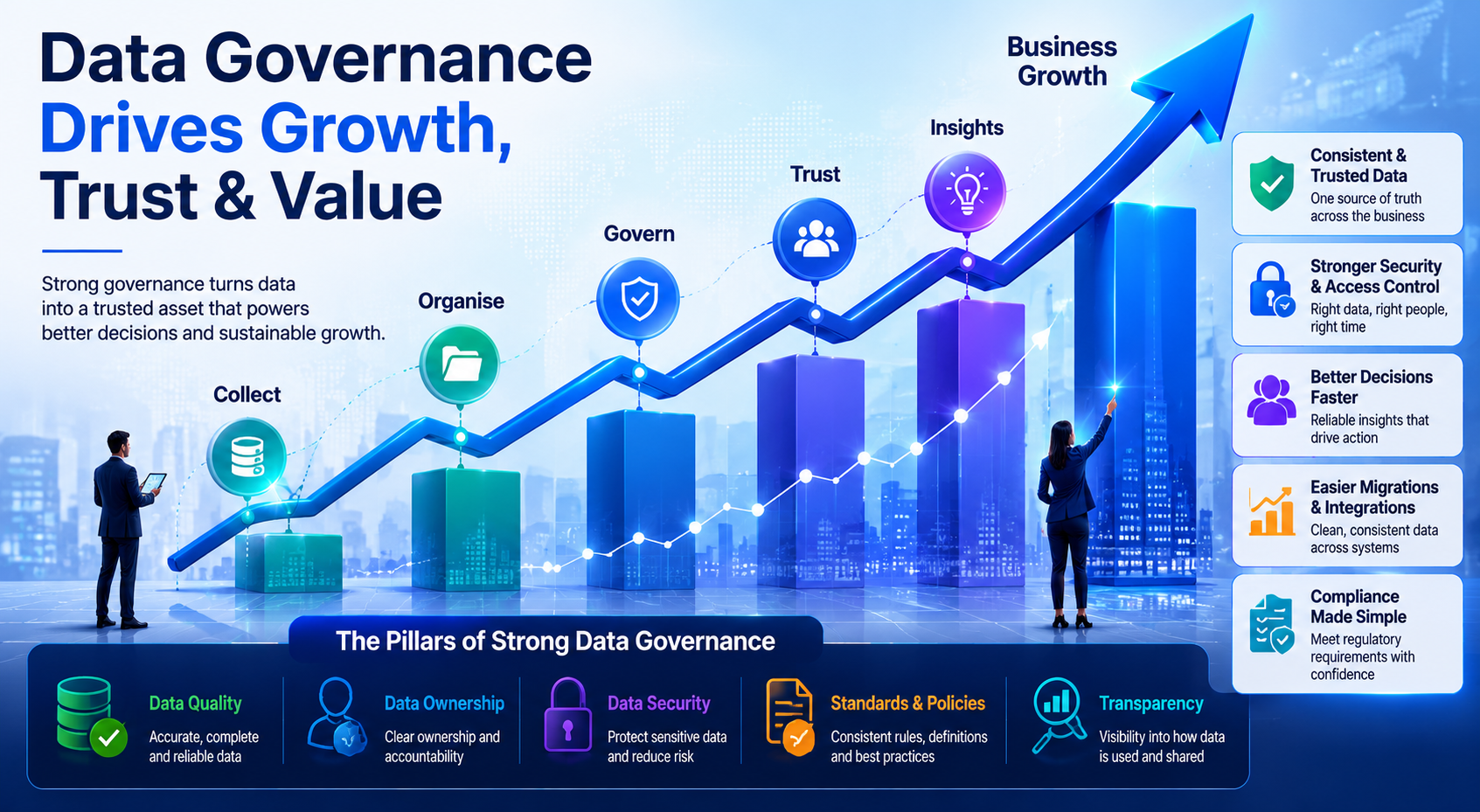
When it’s done well, governance improves trust in the numbers, strengthens security, and reduces time wasted on manual fixes or report reconciliation. It also gives businesses the necessary foundation for wider data work. That includes business intelligence, data analytics, data warehousing, and data visualisation, all of which rely on data being consistent enough to use properly in the first place.
Why Data Governance Matters More as Organisations Grow
Growth changes the role data plays in a business. It’s no longer just there to support reporting; it starts shaping operational decisions, commercial planning, customer strategy, compliance, and long-term investment. As that reliance grows, so does the impact of weak governance.
The challenge is not just size. It’s change. As businesses expand, introduce new systems, migrate data, or roll out new software, the number of places where data can be duplicated, misclassified, altered, or misunderstood tends to increase. That complexity creates risk, but it also creates drag. Teams spend more time checking figures, questioning definitions, managing access issues, and untangling reporting inconsistencies that should have been resolved much earlier.
A few common pressure points tend to appear:
- Reporting becomes harder to trust because different teams define the same figures in different ways.
- Decision-making slows down because people spend too much time validating the data before they can act on it.
- Security risk increases because access grows without the same level of control, visibility, or accountability.
- Compliance becomes more demanding because growth, new systems, and changing regulatory expectations make it more important to clearly explain how data is used, stored, and protected.
- Expansion gets more complicated because new systems, business units, or acquisitions are harder to integrate without agreed standards.
What Industries Benefit Most from Data Governance?
Almost every sector benefits from stronger governance, but the need becomes especially obvious in industries where data volumes are high, systems are complex, or scrutiny is constant.
In banking and financial services, governance supports auditability, risk management, access control, and confidence in regulated reporting. In healthcare, it helps organisations manage sensitive information more carefully while improving consistency across operational and patient-related data. In retail and e-commerce, it supports cleaner reporting across customer, sales, product, and inventory data, especially when multiple channels are involved.
It also matters in insurance, telecommunications, logistics, and large service-based organisations where data flows across many teams and platforms. In these environments, governance ensures data is usable at scale and reduces the friction that comes from inconsistency.
Future-Proof Your Business with FIRN’s Data Governance
At FIRN, we help organisations strengthen data governance in a way that reflects where they are now, not where a generic framework assumes they should be. Some businesses already have solid data warehousing in place but need clearer ownership, tighter access controls, or more consistent definitions across reporting. Others have reporting up and running, but the logic underneath it needs work before their business intelligence or data analytics can be relied on with confidence.
In some cases, the priority is strategic: stepping back through data consultancy to identify governance gaps, clarify responsibilities, and create a structure that can support future growth. In others, it’s more practical, improving the way data is stored, modelled, and surfaced so teams can trust what they’re seeing day to day. That might involve strengthening the underlying environment, improving how metrics are handled in Power BI, or making sure data visualisation reflects governed, consistent information rather than polished confusion.
If your organisation’s grown faster than its data processes, or you’re simply not sure whether your current setup is giving you enough control, consistency, or confidence, it’s worth reaching out. At FIRN, we work with businesses at different stages of maturity, so whether you need to refine what’s already in place or put stronger governance foundations around a more complex environment, we can guide you in the right direction.
Data Governance FAQs
How do I know if my current data governance is actually working?
A good sign is that teams trust the same numbers, ownership is clear, access is controlled, and reporting doesn’t need constant manual checking. If people are still debating definitions or fixing the same issues repeatedly, there’s usually more work to do.
Is data governance only beneficial for large businesses?
No, data governance is a non‐negotiable part of business data foundations for organisations of any size, because it makes data accurate, secure, and usable.In any data migration or new system implementation.
What usually causes data governance to break down over time?
Growth is a common reason. New systems, new teams, and changing reporting needs often outpace the original structure. Governance can also weaken when ownership is unclear or when rules exist on paper but aren’t reflected in day-to-day processes.
What tends to come first: better governance or better reporting?
In most cases, governance needs to come first, or at least develop alongside reporting improvements. Better dashboards won’t fix inconsistent definitions, unclear ownership, or poor-quality source data.
Can data governance support future AI or predictive analytics work?
Yes. Advanced analytics depends on data being consistent, well-structured, and trustworthy. We can help create a strong governance foundation to help businesses more easily adapt to AI, automation, and predictive modelling later on.