For many New Zealand businesses, AI feels like it has gone from interesting to unavoidable in record time. One moment, it was a topic reserved for technology conferences. The next, every software platform seemed to launch an AI feature, and every industry discussion became centred around automation, productivity, and machine learning.
For mid-sized businesses, the challenge is not deciding whether AI has potential. The challenge is adopting it in a way that creates value without introducing unnecessary risk.
The businesses seeing the strongest results from AI are rarely the ones rushing to implement the latest tools. More often, they are the organisations that have invested time in understanding their data, improving reporting, and building the foundations needed to support AI effectively.
Start With a Business Problem, Not an AI Tool
One of the most common mistakes businesses make is starting with the technology itself.
A software vendor launches a new AI feature. A competitor announces an AI initiative. A leadership team decides the organisation needs an AI strategy. The result is often a search for ways to use AI rather than a search for problems worth solving.
Successful AI adoption usually works the other way around.
Instead of asking, “How can we use AI?”, businesses should ask, “What challenge are we trying to solve?”
For example:
- Are sales forecasts consistently inaccurate?
- Is customer churn difficult to predict?
- Are teams spending hours producing manual reports?
- Is demand planning becoming more difficult?
- Are operational risks being identified too late?
When AI is connected to a specific business objective, it becomes easier to measure value, gain stakeholder support, and achieve meaningful outcomes.
Why Predictive Analytics Is Often the Best Place to Start
When people hear the term AI, they often think of chatbots, content generation tools, or automated assistants. While those applications certainly have their place, many mid-sized businesses gain more immediate value from predictive analytics.
Predictive analytics uses historical and current data to forecast future outcomes. Rather than replacing decision-makers, it helps them make more informed decisions by identifying patterns and trends that may otherwise go unnoticed.
This can support a wide range of business functions.
- Demand Forecasting: Predictive models can help businesses anticipate future demand more accurately, allowing them to optimise inventory, staffing, and operational planning.
- Customer Behaviour Analysis: Businesses can identify patterns in purchasing behaviour, helping them understand which customers are most likely to buy, engage, or leave.
- Revenue Forecasting: Rather than relying solely on historical performance, predictive analytics can provide forward-looking insights that improve financial planning and forecasting.
- Risk Management: Patterns within operational and financial data can help organisations identify risks earlier, allowing teams to respond proactively rather than reactively.
For many organisations, predictive analytics delivers tangible business value while avoiding some of the complexity associated with broader AI deployments.
Understanding the Real Risks of AI Adoption
The discussion around AI often focuses on opportunity, but organisations should also understand the risks involved. Many AI-related risks have less to do with the technology itself and more to do with how businesses use it.
Poor Data Quality
AI systems rely entirely on the information they receive. If data is incomplete, duplicated, outdated, or inconsistent, AI outputs become unreliable. This is why many organisations discover that their biggest AI challenge is actually a data challenge.
Privacy and Compliance Concerns
Businesses need to understand exactly what information is being shared with AI systems and how that information is being processed. Customer data, employee information, and commercially sensitive records all require appropriate safeguards.
Lack of Governance
Without clear ownership and accountability, AI initiatives can quickly become difficult to manage. Organisations need policies around access, usage, monitoring, and oversight.
Blind Trust in AI Outputs
AI can support decision-making, but it should not replace critical thinking. The most successful organisations use AI to augment human expertise rather than relying on automated recommendations without validation.
Business Intelligence Creates a Stronger Foundation for AI
Before businesses can trust AI-generated insights, they need confidence in their existing reporting. The best way to do this is with business intelligence.
Effective business intelligence helps organisations establish consistent reporting, improve visibility across departments, and create a clearer understanding of current performance. When teams trust the information they’re already using, it becomes much easier to build more advanced analytical capabilities.
For example, a business that already has reliable sales dashboards and performance reporting is in a far stronger position to implement AI-driven forecasting than one still relying on disconnected spreadsheets and manual reporting processes.
What Safe AI Adoption Looks Like in Practice
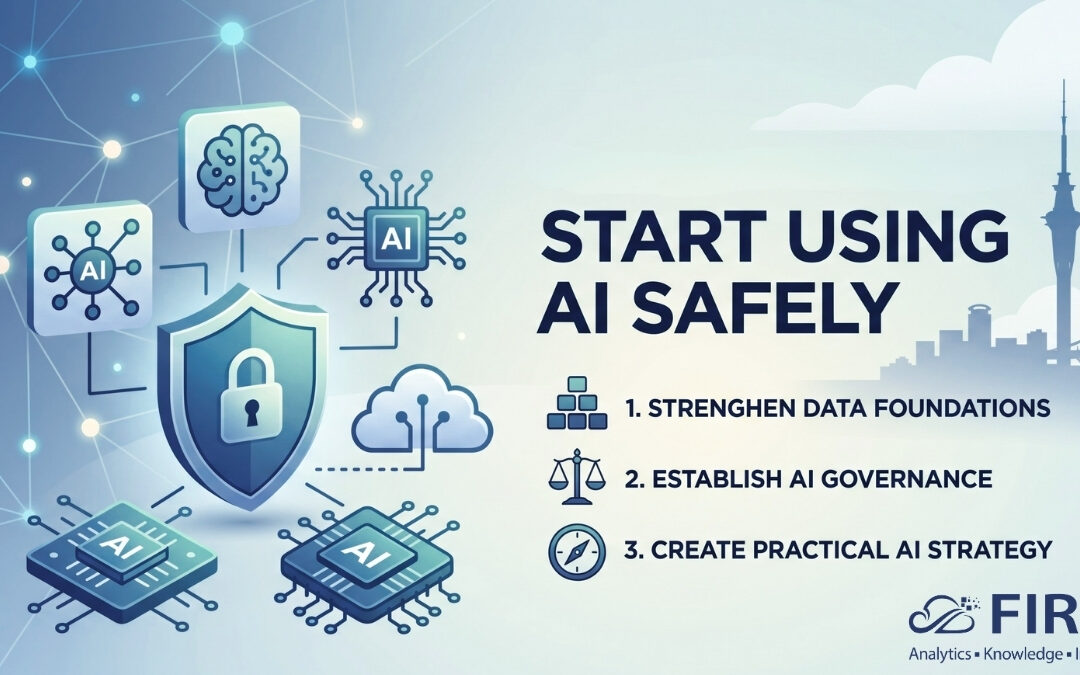
Most mid-sized businesses don’t need to transform overnight to benefit from AI. In many cases, a phased approach delivers stronger results and reduces unnecessary risk. A practical path often looks like this:
- Assess current reporting and data quality.
- Improve visibility through business intelligence.
- Identify high-value business challenges.
- Introduce predictive analytics in targeted areas.
- Expand AI capabilities as confidence and maturity grow.
This approach allows organisations to generate value at each stage while maintaining control over risk and investment.
Build AI Capability With Confidence
For mid-sized New Zealand businesses, AI presents genuine opportunities to improve forecasting, support decision-making, and create operational efficiencies. The key is knowing where to start.
Rather than chasing every new AI trend, successful organisations focus on practical use cases, trusted data, and measurable outcomes. They build confidence through business intelligence, strengthen their data foundations, and implement solutions that solve real business problems.
At FIRN, we help businesses take that approach. Through our data consultancy services, business intelligence expertise, and predictive analytics solutions, we help organisations identify opportunities, assess AI readiness, and implement data-driven strategies that support safe and effective AI adoption.
If you’re exploring AI for your organisation, reach out to FIRN about building a practical roadmap that delivers value while managing risk.
AI Adoption FAQs
What is the safest way for businesses to start using AI?
The safest approach is to begin with a clearly defined business problem and ensure your data is reliable before introducing AI solutions. Starting with predictive analytics often provides measurable value while keeping risk manageable.
What are the biggest AI risks for businesses?
Common risks include poor data quality, privacy concerns, weak governance, overreliance on automated outputs, and a lack of visibility into how AI-generated recommendations are produced.
Is predictive analytics a form of AI?
Predictive analytics often uses advanced statistical models and machine learning techniques to forecast future outcomes. It’s widely considered one of the most practical business applications of AI.
Why is business intelligence important before AI adoption?
Business intelligence helps organisations establish trusted reporting, improve visibility, and create a single source of truth. These foundations make future AI initiatives more effective and reliable.
How can FIRN help businesses adopt AI?
FIRN helps organisations improve data quality, strengthen business intelligence, implement predictive analytics solutions, and develop practical strategies that support safe and effective AI adoption.