
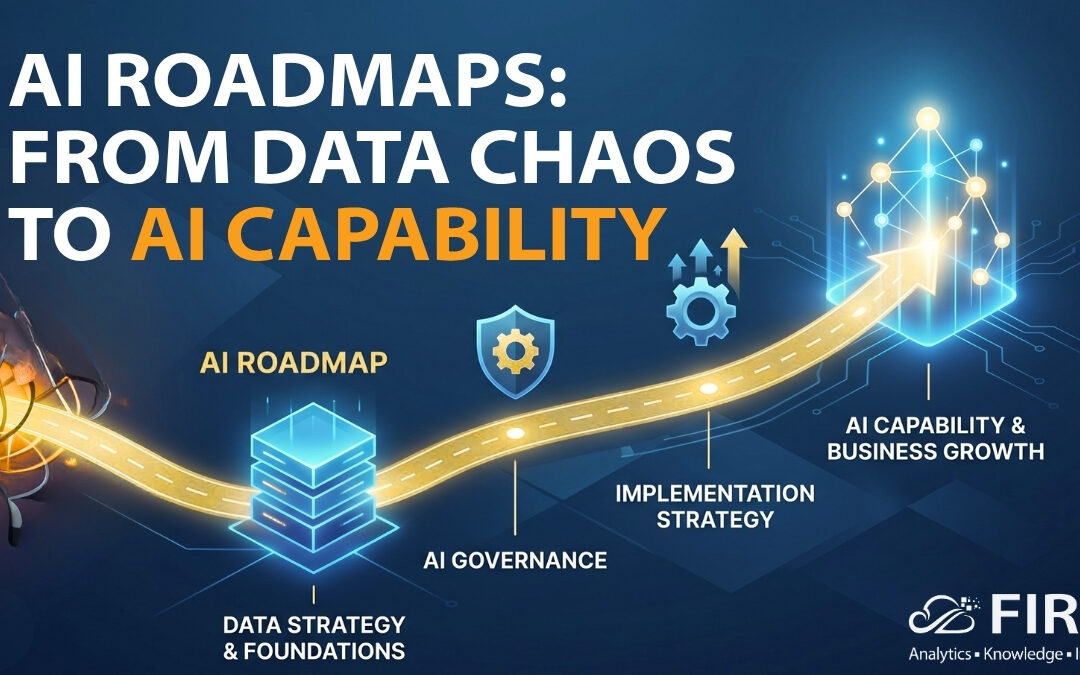
Artificial intelligence has quickly become the boardroom’s favourite topic. Every week seems to bring another announcement about AI-powered tools, automated decision-making, or organisations claiming dramatic productivity gains. The challenge is that many businesses are trying to sprint towards AI while still struggling with the fundamentals of data management.
The reality is simple. AI cannot fix poor data. It cannot magically connect disconnected systems, resolve conflicting reports, or compensate for inconsistent business processes. In many cases, AI simply exposes the data problems that have existed for years.
An effective AI roadmap helps businesses address those challenges first, creating a clear path from fragmented data environments to practical, scalable AI capability.
Why Businesses Struggle With AI Adoption
Many organisations begin their AI journey by focusing on tools rather than outcomes. They invest in platforms, pilot projects, or automation software before fully understanding whether their underlying data can support those initiatives.
This often creates frustration. AI models produce unreliable outputs, reporting becomes inconsistent, and teams lose confidence in the results. What looked promising during a demonstration becomes much harder to scale across the business.
Several common challenges tend to appear repeatedly:
- Data is spread across multiple systems with no single source of truth.
- Inconsistent reporting definitions between departments.
- Poor data quality and duplicate records.
- Limited governance around data ownership and access.
- Unclear business objectives for AI initiatives.
These issues are not technology problems; at their core, they’re data problems. Before organisations can develop advanced AI capabilities, they need a clear understanding of how their information is collected, managed, governed, and used.
What Is an AI Roadmap?
An AI roadmap is a strategic framework that guides an organisation from its current state to its desired AI maturity. Rather than focusing solely on technology deployment, it connects business priorities, data readiness, governance, people, and processes. Think of it as the bridge between ambition and execution.
A strong AI roadmap typically answers several critical questions:
- What business challenges are we trying to solve?
- Is our current data environment ready for AI?
- What capabilities do we need to develop first?
- Which AI opportunities will deliver the highest value?
- How will success be measured?
Without these answers, AI projects can quickly become expensive experiments. With them, businesses can prioritise investments, reduce risk, and create a clear path towards long-term capability. While many might assume an AI implementation strategy is all about deploying as much AI as possible, the best ones focus on deploying the right AI in the right areas at the right time.
The Foundation: Building Strong AI Data Foundations
Before discussing machine learning models, generative AI, or predictive analytics, businesses need to address a more fundamental question: Is their data fit for purpose?
AI systems depend entirely on the quality of the information they receive. If the underlying data is inaccurate, incomplete, duplicated, or poorly structured, the outputs will reflect those weaknesses.
Strong AI data foundations typically include:
Data Quality Management
Data quality is often one of the largest barriers to successful AI adoption. Information may exist across multiple systems with conflicting formats, missing values, or outdated records. Establishing consistent standards helps ensure that AI models are working with reliable information.
Data Integration
Many organisations operate with disconnected platforms across finance, operations, sales, marketing, and customer service. AI performs best when these data sources can be brought together into a unified environment that provides a complete view of the business.
Governance and Security
As AI becomes more embedded in decision-making, governance becomes increasingly important. Businesses need clear rules around ownership, access, privacy, compliance, and accountability. Without governance, even technically successful AI projects can create operational and regulatory risks.
Data Warehousing and Infrastructure
Modern AI initiatives often require scalable infrastructure capable of supporting large volumes of data. Data warehouses and centralised reporting environments help provide the consistency and accessibility that AI solutions require.
Aligning AI With Business Objectives
One of the most common mistakes organisations make is treating AI as a technology project rather than a business initiative.
The most successful AI programmes begin with business goals.
For example, a retailer may want to improve demand forecasting. A financial services provider may want to reduce manual processing. A healthcare organisation may be looking to improve operational efficiency. In each case, AI serves a specific business objective rather than becoming an objective in itself.
This approach provides several advantages.
- First, it helps prioritise investment. Instead of pursuing every possible use case, businesses focus on opportunities with the greatest potential impact.
- Second, it improves stakeholder engagement. Teams are more likely to support AI initiatives when they understand how those initiatives contribute to business outcomes.
- Third, it creates measurable success criteria. Rather than simply asking whether an AI project works, organisations can evaluate whether it improves efficiency, reduces costs, increases revenue, or enhances customer experience.
- A practical AI strategy for business should always begin with business priorities and work backwards towards technology.
Creating a Realistic AI Implementation Strategy
Once data readiness and business objectives are understood, organisations can begin developing a structured AI implementation strategy.
This typically involves phased delivery rather than attempting large-scale transformation all at once.
Phase One: Assess Current Readiness
The first step is understanding the current state of data, systems, reporting, governance, and organisational capability. FIRN’s data consultancy service can identify gaps that could impact future AI initiatives.
Phase Two: Strengthen Data Foundations
Before introducing advanced AI tools, businesses should address data quality issues, improve integration, establish governance frameworks, and create more reliable reporting environments.
Phase Three: Identify High-Value Use Cases
Not every AI opportunity deserves immediate attention. Organisations should prioritise projects that offer measurable business value while remaining achievable within current capabilities.
Phase Four: Pilot and Validate
Small-scale pilots allow businesses to test assumptions, measure outcomes, and refine approaches before wider deployment. This reduces risk while building organisational confidence.
Phase Five: Scale and Optimise
Successful pilots can then be expanded across departments, supported by ongoing monitoring, governance, and continuous improvement processes.
This staged approach often produces stronger results than large, ambitious programmes that attempt to transform everything simultaneously.
Build Your AI Roadmap With FIRN
AI has enormous potential, but potential alone does not create business value. The organisations seeing meaningful results are not necessarily the ones investing most aggressively in AI. They’re the ones building the strongest foundations beneath it.
At FIRN, we help businesses move beyond AI experimentation and towards sustainable capability. By aligning business goals, data strategy, governance, and implementation planning, our data consultancy team creates AI roadmaps that are practical, scalable, and built for real business use.
If you’re exploring AI adoption and want to know whether your data is ready, talk to FIRN about creating a roadmap that turns data chaos into genuine AI capability.
AI Roadmap FAQs
What is an AI roadmap?
Why is data important for AI?
AI depends on accurate, connected, and well-structured data. If business data is duplicated, inconsistent, or trapped across disconnected systems, AI outputs become harder to trust, which is why strong data consultancy services are often the first step.
What role does business intelligence play in AI adoption?
Business intelligence helps businesses understand what their data is already saying before they introduce AI. Clear dashboards, reporting structures, and performance insights make it easier to identify where AI can add genuine value.
Can AI work with existing reporting tools?
In most cases, yes. Existing reporting tools can often be improved or extended to support AI-driven insights, provided the data behind them is accurate, accessible, and properly structured.