
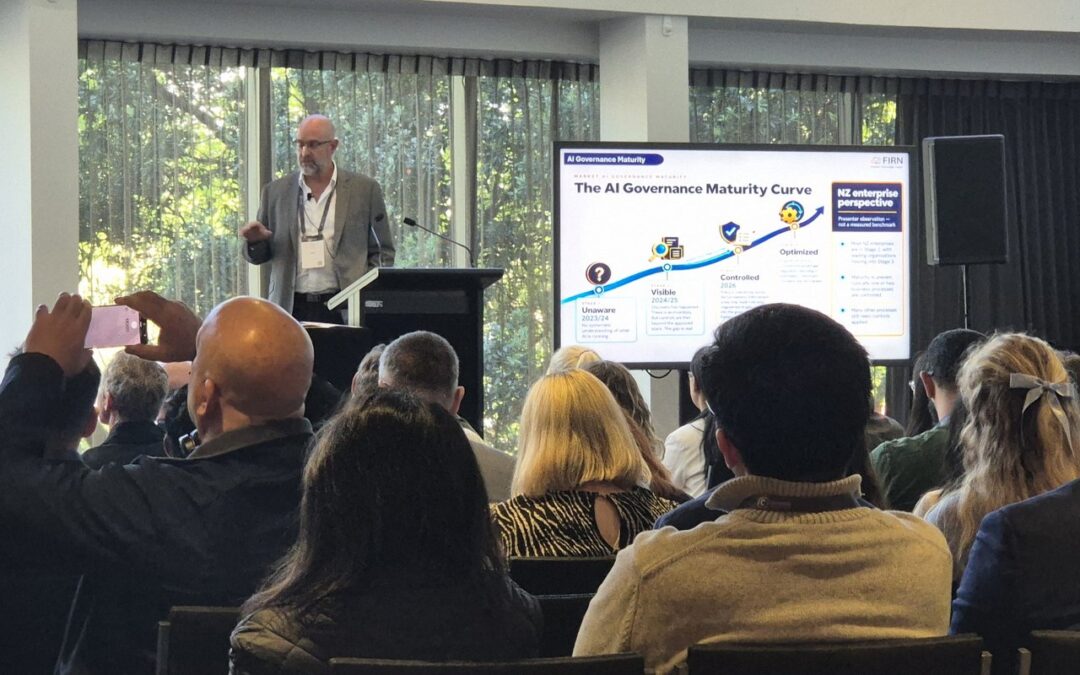
Image: AFQY, live from CDAIO New Zealand, Auckland, 19 October 2026
Based on a presentation by Paul Sadler, Client Director at FIRN, at CDAIO New Zealand.
AI agents are moving into everyday business processes. As more teams introduce them, business leaders need a clear view of what they do, what information they use and who is accountable for their actions.
At 2026 CDAIO New Zealand, FIRN Client Director, Paul Sadler, explored these challenges in his presentation, From Proliferation to Control: Managing ‘Agent Sprawl’ in the Enterprise AI Era. His message: established governance disciplines provide a useful starting point, but they need to reach every process where agents operate.
How AI agent sprawl develops: A familiar pattern with new consequences
Cloud adoption and the growth of APIs followed a similar path. Teams moved quickly, technology spread, and governance had to catch up.
AI agents bring another version of this challenge. Individual teams can introduce useful capabilities while the wider organisation loses visibility of permissions, dependencies and costs. This is agent sprawl.
Paul illustrated the challenge with an analogy: a highly capable young child with extraordinary persistence. An agent can keep pursuing its assigned objective, making clear instructions, boundaries and oversight essential.
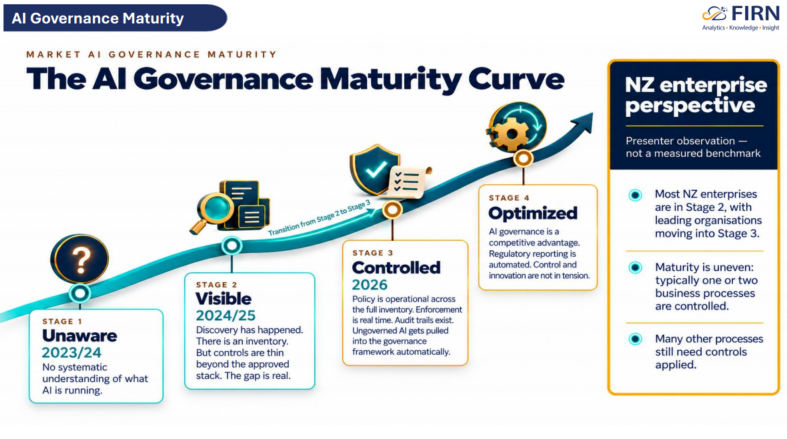
Figure 1. The AI Governance Maturity Curve. 4 Stages: Unaware, Visible, Controlled and Optimised. Source: Paul Sadler, FIRN — From Proliferation to Control, CDAIO New Zealand.
Moving towards enterprise AI agent governance
Paul described four stages of AI governance maturity: Unaware, Visible, Controlled and Optimised.
Knowing which agents exist establishes visibility. Moving towards control means applying policies across that inventory, enforcing permissions and maintaining audit trails.
In Paul’s observation, many New Zealand enterprises are at the Visible stage, with leading organisations moving towards Controlled. This was a consulting perspective rather than a measured market benchmark. Maturity can also vary within one organisation: controls around one process may be well established while others remain fragmented.
A framework for managing AI agents: Build three layers on a trusted data foundation
Paul outlined an emerging approach with three operating layers and one shared foundation.
- Organisation establishes who owns outcomes and decisions. A business owner remains accountable for the work, including the actions delegated to agents.
- Operations and control manages the agent lifecycle. Registration, evaluation, monitoring and retirement help teams understand what is running and whether it remains appropriate.
- Orchestration coordinates work between people, agents and systems. Defined handoffs, validation checks and human review of exceptions help prevent errors from travelling through an entire process.
Underneath these layers sits a shared context foundation: structured, trusted data with consistent meaning, clear origins, appropriate access and maintained freshness. Agents need this context to interpret information and apply business rules reliably.
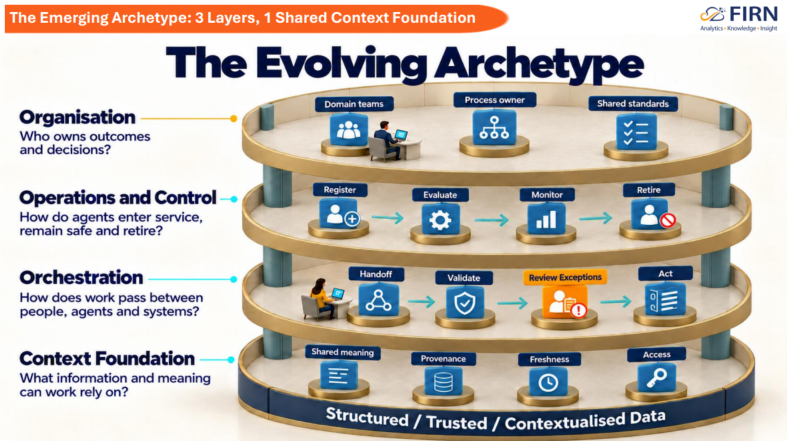
Figure 2. Three layers, one shared context foundation. Organisation, operations and control, and orchestration define how AI agents are owned, managed and coordinated. Source: Paul Sadler, FIRN — From Proliferation to Control, CDAIO New Zealand.
Extend accountability across the whole process
Paul traced the development of operating models from isolated teams to centres of excellence and federated approaches.
In a federated model, business teams contribute their requirements, data and business logic. A central team provides shared controls, testing and reusable services. This gives teams a common foundation while retaining responsibility for their own work.
The emerging next step is end-to-end ownership: one accountable owner for the complete process, supported by teams working across departmental boundaries. It requires more coordination, particularly where agents pass work between business units.
Make authority, consequences and visibility explicit
Whatever operating model an organisation adopts, Paul highlighted three requirements:
- Authority: approve what each agent can do and match its permissions to its task.
- Consequences: understand expected outcomes and what could happen when something goes wrong.
- Visibility: keep agents monitored, managed and reportable throughout their lifecycle.
Looking ahead, Paul anticipated stronger agent security, more explicit context and trust controls enforced outside the model itself. Independent verification, protected audit records and the ability for people to stop actions will become increasingly important.
For business leaders, a practical starting point is one operational process. Identify its agents, owners, permissions and handoffs, then examine the data each step relies on. That creates a concrete basis for deciding where stronger controls are needed.
Ready to bring clearer control to your AI agents?
Strengthen the data foundations behind your operational AI. Explore FIRN’s Data Consultancy Services or contact us to discuss your AI governance and data foundations.