

How Data Warehousing Helps NZ Businesses | © 2026 FIRN
A business’s forecast is only as good as its decision-making skills, and those decision-making skills are only as good as the data they’re built on. Most businesses choose to get by on a mix of exports, spreadsheets, and reports that were never designed to line up, and for a while, that feels workable. Then the business grows, systems multiply, and the cracks appear: numbers don’t match between teams, reporting turns into a manual slog, and simple questions take far too long to answer. You might not be “losing” data outright, but you are losing trust in it, which is where forecasts start to wobble, and decisions become slower than they should be. At that stage, having the right organisational system behind you can be make or break, and data warehousing is the most practical way to pull everything into one structured, reliable source of truth.
What is Data Warehousing?
Data warehousing is one of the most important decisions a business can make, because it sets the standard for how information is stored, trusted, and used across the organisation. Much like normal warehousing, it’s not about having more stock; it’s about having the right stock in the right place, labelled properly, and ready to be picked without someone rummaging around in the back.
A data warehouse consolidates data from multiple sources into a single, structured system, making it easy to retrieve, analyse, and act on information without rework and second-guessing. Instead of every team pulling their own extracts from finance, sales, operations, and marketing, the warehouse becomes the central location where that data is cleaned, aligned, and organised around consistent definitions. The practical result is that reporting and analysis stop depending on who built the spreadsheet, and start running off a shared, reliable foundation that can scale as your business and systems grow.omes together.
Data Warehousing: Building a single source of truth for NZ Business | © 2026 FIRN
How Data Warehousing Helps a Business’s Daily Operations?
Organisational Help
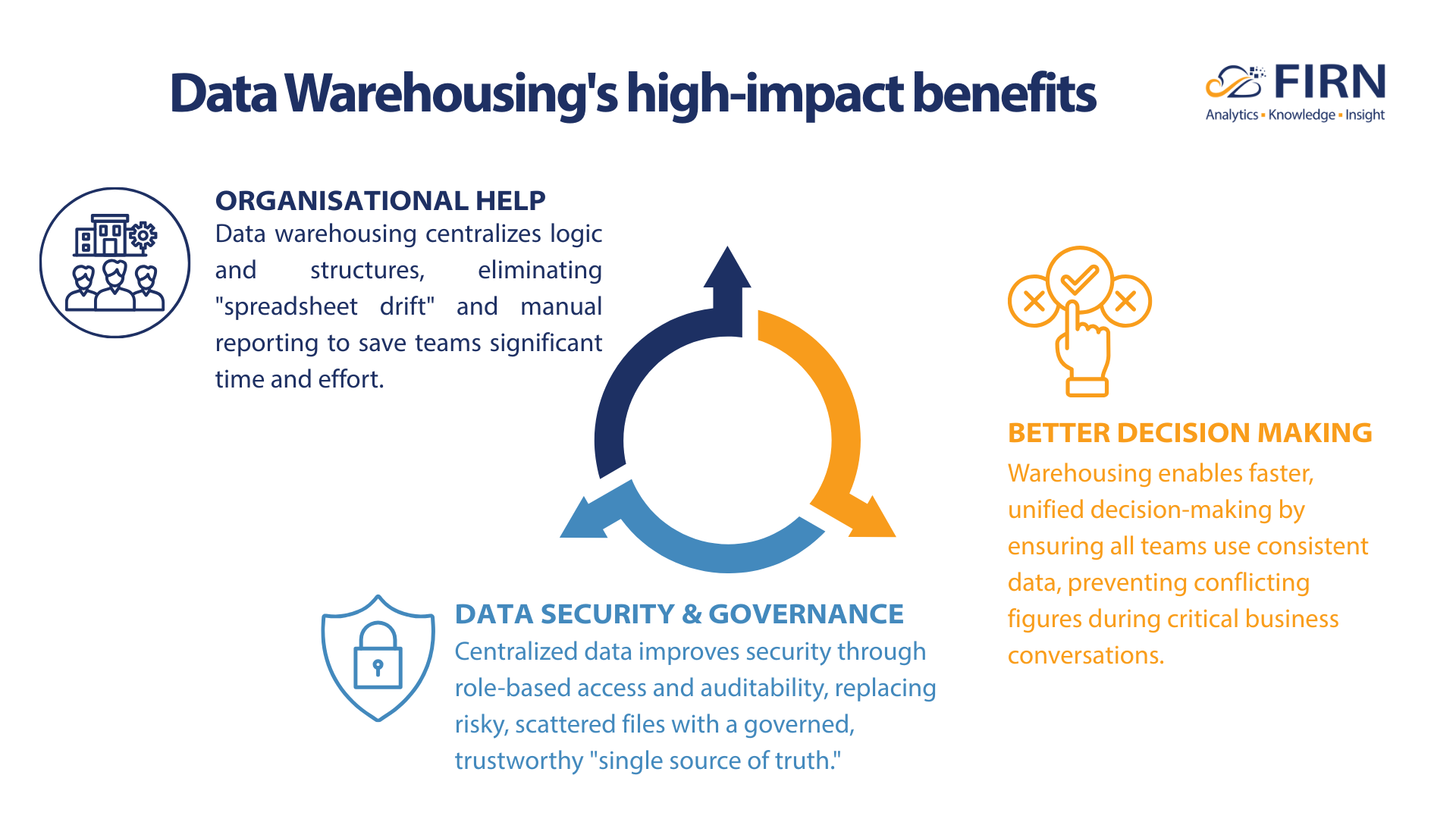
Most businesses that have considered data warehousing think of the obvious benefit, the organisational aspect. And to be fair, it is excellent for organisation: you get consistent naming, cleaner structures, fewer duplicate files, and far less time wasted hunting through folders, exports, and half-updated dashboards. It also reduces the “spreadsheet drift” problem, where the same report gets copied, tweaked, and re-saved until no one can tell which version is meant to be trusted. When data is warehoused properly, you’re not rebuilding the same logic in five different places, because the core definitions and transformations live in one controlled environment. That alone can take a serious load off teams who’ve been stuck doing manual reporting just to keep leadership informed.
Better Decision Making
However, the organisational benefits aren’t the main point; they’re the enabling layer for better decision-making. The real value is that a warehouse gives you one overview of performance that is consistent across teams, so decisions happen faster and with fewer compromises.
For example, let’s say you have a customer-facing team preparing a renewal proposal for a key client, while finance is checking margin, and operations is confirming delivery performance. Without a warehouse, each team pulls numbers from different systems at different times, and you end up with conflicting figures in the same client conversation, which is both avoidable and reputationally risky. With a data warehouse, those teams are working from the same underlying data model, so the numbers align, the narrative holds up, and the conversation stays focused on what to do next rather than which report is “right”.
Data Security Protection
There’s also a security and governance advantage that matters more than many people expect. When data is scattered across desktops and shared drives, sensitive information tends to travel further than it should, and access is hard to control. A well-designed warehouse supports encryption, role-based access controls, and auditability, so the right people see the right data, and you’ve got a clear record of how it’s used. For businesses handling personal or commercially sensitive information, it’s a necessary risk reduction. In short, data warehousing makes decision-making more straightforward because it replaces guesswork and reconciliation with consistent data, and it does it in a way that’s easier to govern properly.
Data Warehousing high-impact benefits | © 2026 FIRN
Experience Genuine Growth with Data Warehousing Experts
We know that the proof is in the pudding. Plenty of people can explain what data warehousing should do, but what matters is whether it actually holds up in a real business with legacy systems, tight timelines, and stakeholders who need answers they can trust. We’ve seen what changes when a warehouse is implemented properly: teams stop spending time reconciling reports, leaders stop second-guessing numbers, and the business can act faster because the data foundation isn’t fighting back.
Think Data Warehousing Could Help You Grow?
If you’re ready to build a single source of truth that actually scales with your business, reach out. Our experts can help you design and deliver a data warehouse that fits your systems, goals, and governance needs.
Data Warehousing FAQs
What’s the difference between a data warehouse and a data lake?
A warehouse is structured and designed for consistent reporting and business intelligence, so metrics line up across teams. A data lake is more flexible for storing raw or unstructured data, but it can get messy without strong governance.
Confidentiality is a priority for me. Can data warehousing help?
Yes, when it’s set up properly, data warehousing improves privacy. Access can be locked down with role-based permissions, encryption, and audit logs, which is far safer than sensitive data living in exports and spreadsheets.
Is data warehousing only for large enterprises?
No. SMEs often benefit quickly because they feel the pain of manual reporting sooner, and a cloud warehouse can scale without big upfront infrastructure costs.